


• Home
  • About
  • Contact
Cineblur

Brent Pierce

  • Demo Reel
  • Portfolio
  • Archive
  • Tips and Tricks
  • Paid Stuff
  • Free Stuff
The-Hunger-Games-Wallpapers-1

The Hunger Games: 2 Cinematography Lessons to be Learned

Posted on August 29, 2012 by Brent Pierce
Let me start off by saying that “The Hunger Games” was a great movie. I loved it. It was very well done, and created by very talented people.

The goal of a cinematographer is to bring the audience INTO the story and make the viewers feel so connected, that they cry or laugh when something happens, feeling as though it’s happening to them at that very moment.

While watching “The Hunger Games” for the first time, I was completely absorbed in the story and the plot and for the most part, I LOVED the camera work, and kept finding myself complimenting certain aspects of the cinematography. There are just a couple things that I found that should be obvious no-no’s. Things that stood out to me as I watched, and did not keep me immersed in the story. Things that are basics in film class and should be taught first semester. Things that the director should do everything in his power to reshoot and fix.

I’ll explain 2 scenes with “errors” that I noticed in this film that should have been addressed.

1. The camera crossed the line of action, and broke the 180 degree rule.

The 180 degree rule is basically this: imagine a line going through your scene that the camera cannot pass. To abide by the 180 degree rule, the camera must stay on 1 side of the line and on one side of the action, keeping the character in relative position to the camera. Look at the picture below for an illustration.
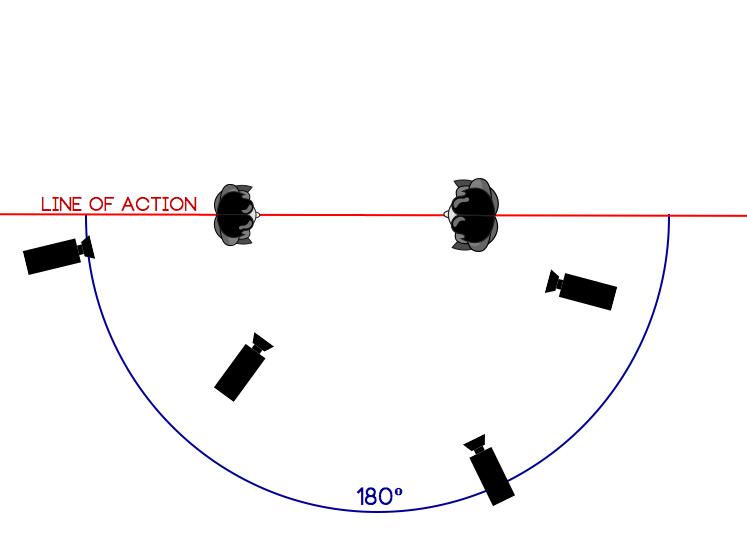
The camera should not cross the “line of action”

The subject on the left should remain on the left throughout the entire scene, even with different camera placements. This is to not create confusion in the scene. Even slight, subconscious confusion will take the viewer’s emotion out of the scene.

Now, of course, rules are made to be broken. In alot of action films, or scenes with alot going on, you’ll notice that the “line of action” gets crossed quite often. That’s ok, because there is alot going on and it’s ok in that scenario to show different perspectives like that.

But, in “The Hunger Games,” that line was crossed during a very simple dialogue scene. Two characters, face-to-face, Primrose (the younger girl) on the left, and Katniss (the older girl) on the right. Then, on a close-up of their hands (at 20 seconds), they were all of a sudden flip-flopped, with Primrose on the right. WHAT!?

Watch the video below to see what I’m talking about. First, is the original, how it was shot. Second, edited to show how it SHOULD have been shot.

During the over-the-shoulder-shots, Primrose was always on the left. So, I could only assume that on the close-up of their hands, she would still be on the left. When I watched this for the first time, I was honestly puzzled for a few seconds. I wasn’t sure who’s hands I was looking at, and it is VERY important to understand what is happening in the scene at that time.
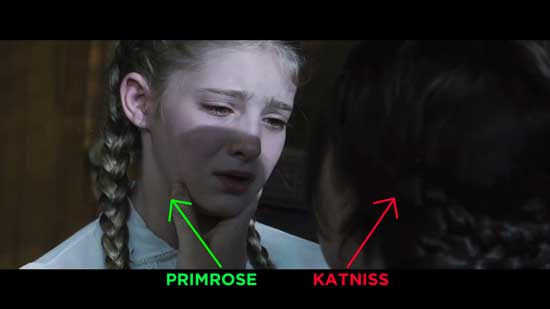
ORIGINAL ANGLE: Primrose on the left, Katniss on the right
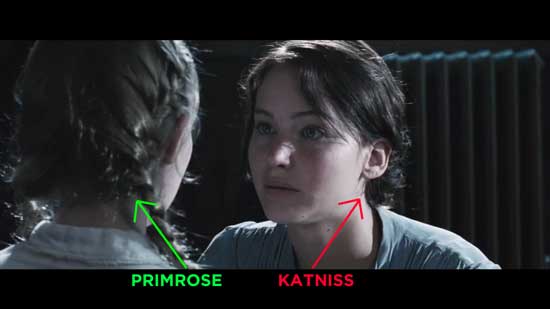
ORIGINAL ANGLE: Primrose on the left, Katniss on the right
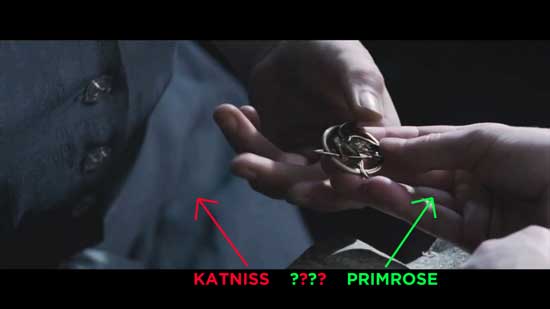
ORIGINAL ANGLE: Katniss on the left, Primrose on the right

In scenes like that, it is VERY important to maintain the 180 degree rule. As a director, make sure you are always thinking about where the camera should go, and how it affects the scene.

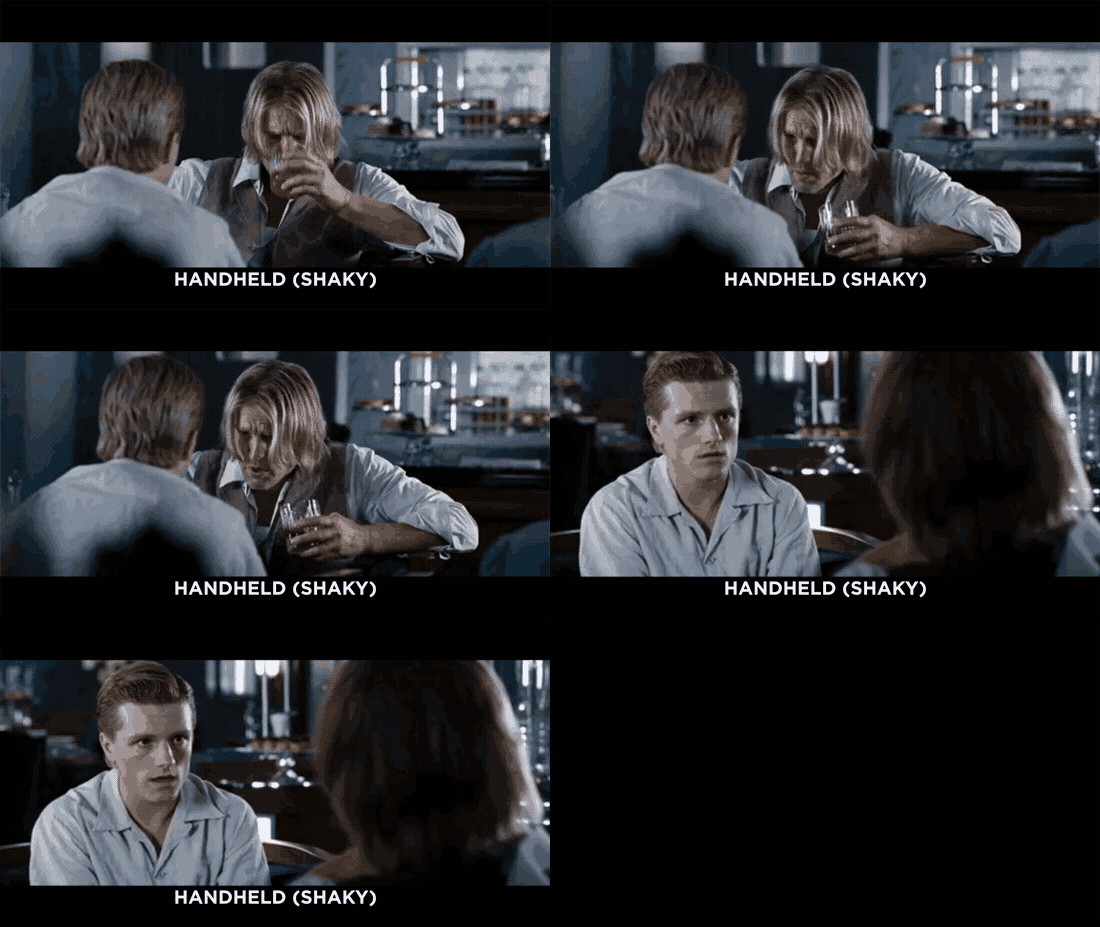
2. The camera cut from a “shaky” shot to a “steady” shot.

It was another simple dialogue scene where two characters were talking face-to-face. The angles were similar, over-the-shoulder shots going back and forth to each character. The problem was, that one character’s angle was handheld, and the other’s was completely steady, not making for a smooth cut between the two.

Watch the video below. First, is the original, how it was shot. Second, edited to show how it SHOULD have been shot.

It’s a subtle difference between the two cameras, but it’s enough to bug the viewer and take their attention from the emotion. It makes much more sense to just run both cameras handheld. There is no justifiable reason to switch it up in a scene like that. Most of the shots in this scene were handheld, I think that’s why the sudden “tripod” shot was so distracting. Sometimes, it’s not a problem going from a handheld, “shaky” shot to a locked-off, “steady” shot, but in this case, it was.
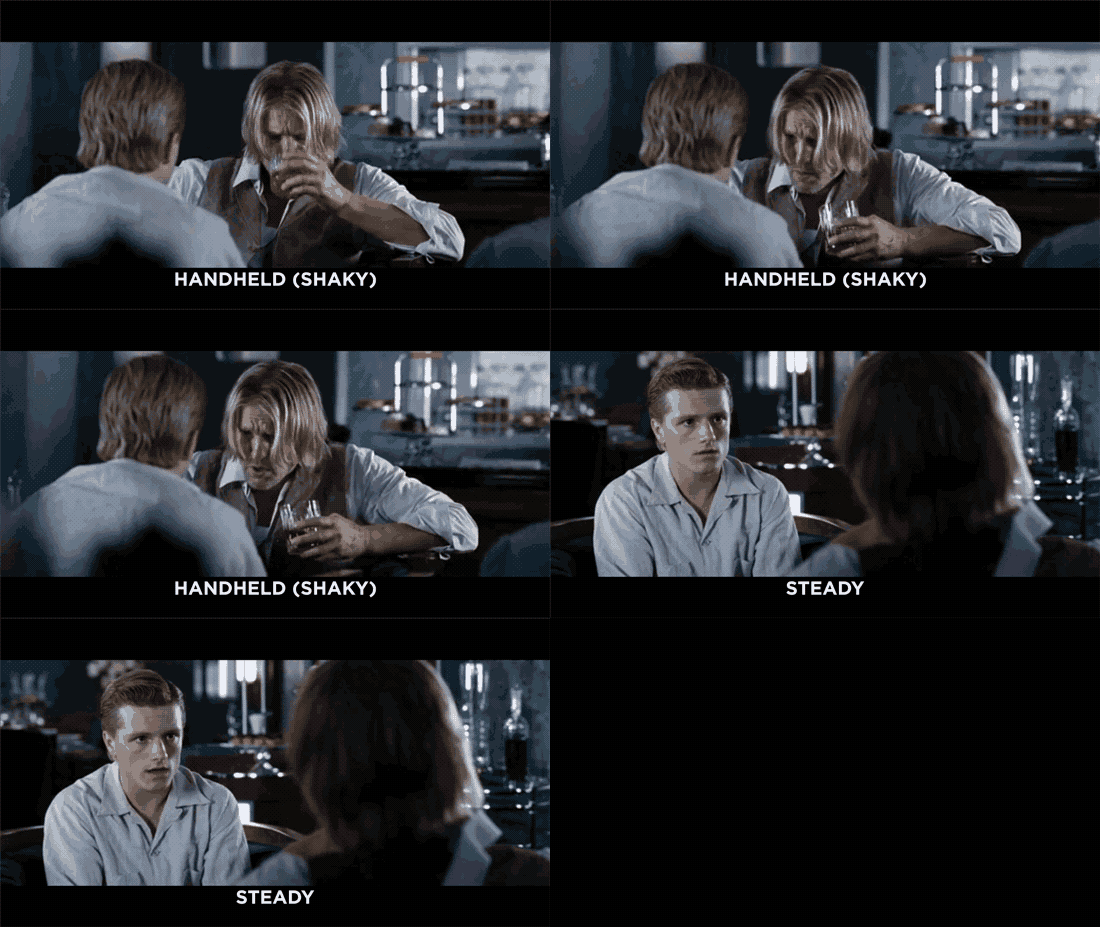
Original

Fixed (added shake to 2nd shot)

Everything has to serve a purpose to help tell the story. If the “steady” shot would have helped to convey an emotion, such as the character feeling calm and steady, or coming to a certain intelectual realization, that would have been ok. But, that was not the case. As the director or cinematographer, try to keep that in mind when shooting a scene with multiple, similar angles. Make sure your cameras don’t distract your audience from the story.

I’m not sure why they decided to shoot the two over-the-shoulder shots differently, but it could have been very easily avoided.

Overall, “The Hunger Games” was an amazing movie, even with these small cinematography blunders. If you haven’t seen it, I strongly encourage you to change that. As a cinematographer, we’re always meticulously dissecting scenes and camera moves during movies. It’ll let you see what good shots look like and get some ideas of your own, but it’ll also help distract you during the movie. A beautiful disease, if I do say so myself.
This entry was posted in Blog, Featured, Tips and Tricks and tagged cinematography. Bookmark the permalink
  • http://twitter.com/jaredryanmedia Jared Bredeson

    Do you think the tripod & handheld scene could have been done that way to emphasize the shaky/drunken/slightly crazy Haymitch vs. the steady/calm demeanor of Peeta in the scene?

    • http://www.cineblur.com Brent Pierce

      I honestly don’t think so. Most of the shots in that entire train section were handheld.
      And Peeta did not seem calm and steady. Performance wise, he seemed anxious and just as unnerved as drunken Hamitch.

  • Roald & Debbie

    I like your blog very much but I think these are just minor “errors”.
    Ok the over shoulder thing is very confusing and the shaky camera is a bit weird but I actually think Jared is right.

    In the end every movie has mistakes and I think it’s impossible on this big productions to make a movie without mistakes.

    We’re currently writing on a scenario for our first short film and I have a lot of respect for those big Hollywood directors because it ain’t easy ;)

    Keep on bloggin, we love reading it from The Netherlands!

    Greets,
    Roald and Debbie Jansen

    Set Vexy Photography
    http://www.setvexy.nl

    • http://www.cineblur.com Brent Pierce

      Yes, the shaky camera was a very minor “annoyance” when I first watched the movie. Not enough to be considered an error, I understand. But it was still enough to catch my attention and bring it up for teaching purposes.

      And yes, making a movie without mistakes is impossible.

      Thanks for reading!

  • Eslibecerra

    Shake was done cuz Haymitch is a drunk and its symbolic to have those shakes so that the audience understands he is never sober. Nothing wrong, I liked it because I understand the characters attitude and iv read all three books.

  • Vixendia

    Yeah, I think crossing the line is ok, if you have a good reason for it. Maybe they felt there was a reason. Generally the line gets crossed for some psychological reason; things have come to a head and the status quo can no longer be maintained. You cross the line at that point to show your world has just been turned upside down. Shaky on the drunk and steady on the tribute makes sense too. What I didn’t like was the reliance on shaky camerawork. Ok, so the games are televised, the camerawork shouldn’t be pristine for that. Also, someone made the argument that shakycam shows something isn’t right in this world. But I just think there are less annoying ways to get that sense across. Standing still and purposely shaking the the camera is something even the documentarians don’t do, it seems only intended to feign art. People will think it’s cool. Not a good reason to use an effect. Also, maybe because it was shot in video, it really looks like video even when they are trying to create a beautiful shot. I’m not sure that’s just the limitations of video or not. Again maybe the cinematographer wanted everything to have a video look.

  • Vixendia

    Seems like much line crossing here. Or maybe the line keeps getting redrawn. But there’s a good line crossing at the point when the “man with no name” draws his gun to fire, then the camera jumps back over to its original side. Once he gets off the train, the line is drawn between him and the  bad guy (Jack Elam) who’s in the middle, with the camera favoring Jack Elam’s right side. This is part of a sorta famous opening scene where they threw out the music and just created the tension using only sound effects, much copied ever since. http://youtu.be/fx15s_HAkgU

  • Lilly Anderson

    hey, i think that this cinematography review is really good, and that you know allot about what you do. :) but i think that the shaky shot showing the back of petas head and haymitchs face is supposed to be an eye view for katniss, like her watching the conversation from the distance. i could be wrong, idk. i know that this movie is fillmed in a third-person limited point of view, (unlike the book in first person) so it cant put katniss’ thoughts into the movie, but thrughout the film they show persons point of view (from katnis and some others) but i think that is what Gary Ross wanted you to procive here, that katnis is just shy and still in a state of shock/bewilderment of what is going on here so she is on-looking the convo between woody and josh from a distance. :)

  • Henrique Santilli Acquaviva

    The example 2 has a reason for that actually. The shaky cam is her POV, they made different movements to make it clear what is she seeing and what only the audience is able to see.

  •  Facebook Twitter YouTube Vimeo RSS
  • Vintage FX Color Presets

    Vintage FX Color Presets

    “Vintage FX” is a preset pack with 33 vintage presets for After Effects and Premiere Pro.

  • Like us on Facebook

  • What is Cineblur

    What is Cineblur

    Cineblur is a filmmaking website by Brent Pierce. It's a place to share tips, tricks, tutorials, and anything else that he might find interesting.

    You can read more about Cineblur here , or contact Brent Pierce here.

  • Filmmaking sites that you should subscribe to

    • 2ReelGuys
    • AE scripts
    • AE tuts +
    • CheesyCam
    • Cinema 5D
    • Express 35
    • Filmmaker IQ
    • Gray Machine
    • Jag35
    • Motionworks
    • Nino Leitner
    • NoFilmSchool
    • Philip Bloom
    • Pro Video Coalition
    • Prolost
    • The Black and Blue
    • Video Copilot
    • Vincent Laforet
    • Wide Open Camera
  • Purchase this kelvin poster

    Purchase this kelvin poster

    Click to purchase my newest poster, "Kelvin."

  • Connect with us:
  • Twitter
  • Facebook
  • Vimeo
  • YouTube
  • RSS
  • © 2013 Cineblur
  • Brent Pierce